Brawl Stars meta tier list: why the current balance shifted
The S-tier of the current Brawl Stars competitive ladder contains three names: Sandy, Max, and Angelo. They represent roughly five to ten percent of the playable roster.
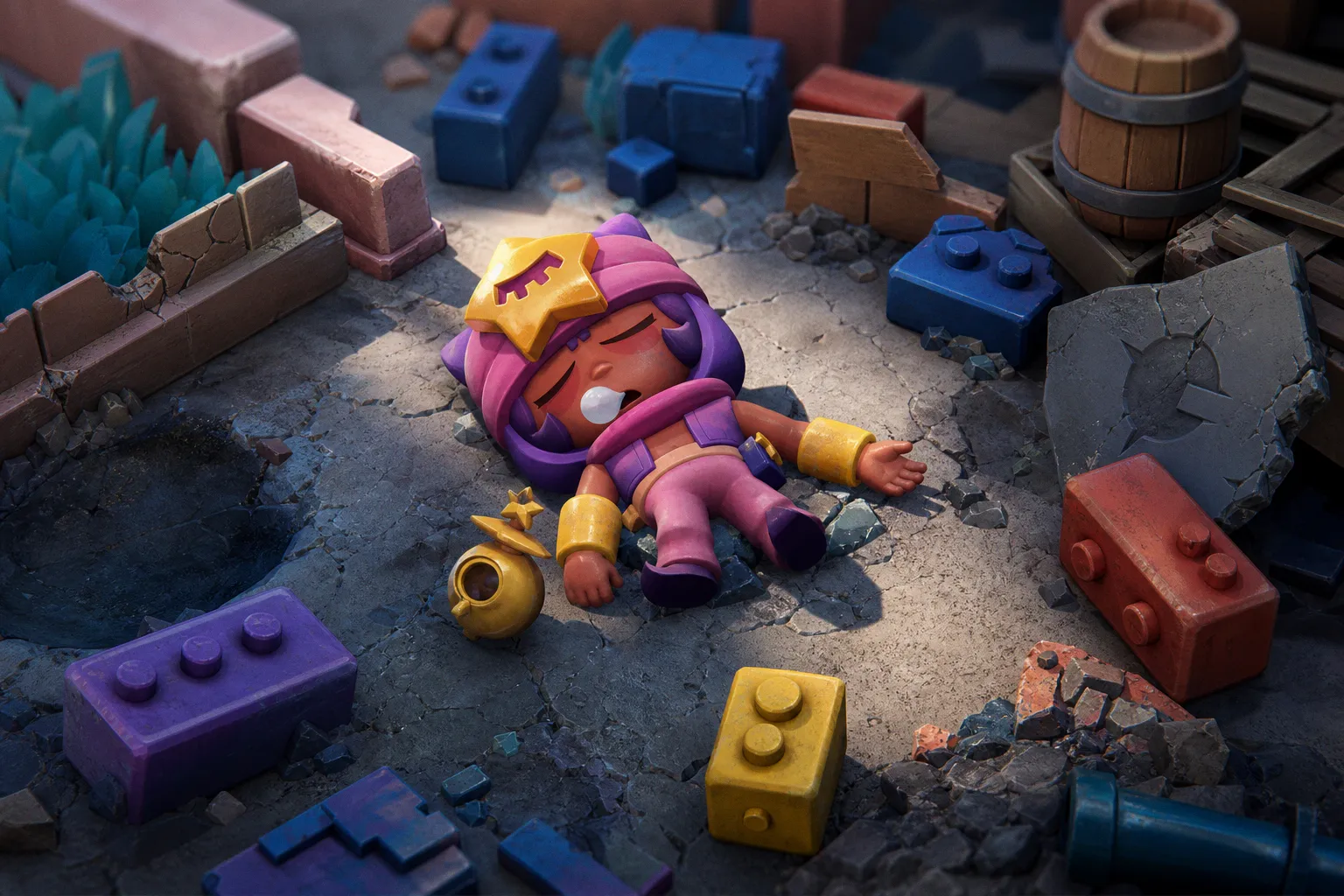
The shift accumulated across two patch cycles. Healing outputs were trimmed. Tank base HP scaling was flattened. Hypercharge charge rates on space-control brawlers were left untouched. The result is a meta where brawlers that bank match momentum through area control and mobility now sit on top of the tier list, and compositions built around raw durability have fallen out of the top competitive brackets.
Three brawlers, one mechanic. Hypercharge uptime above the tempo threshold defines the current S-tier.
The hypercharge dominance: Sandy, Max, and Angelo as tempo engines
Hypercharge, in mechanical terms, is a temporary stat multiplier layered over a brawler's base kit. Charge rate determines activation frequency. Uptime is the proportion of a match spent in the enhanced state. When uptime crosses approximately forty percent of total match duration, the brawler stops being a participant and starts being the pace-setter.
Sandy's hypercharge extends his Super's area of effect and reduces its effective cooldown during the active window. The June patch did not adjust his base cooldowns. What changed was the surrounding ecosystem: counters to sustained area denial received direct nerfs, meaning Sandy now completes his charge-to-deployment cycle with less resistance than in the previous window. His effective uptime in a standard three-minute match has shifted from a marginal advantage to a structural one.
Max operates on a parallel axis. Her hypercharge buffs allied movement speed and reduces her own dash cooldown. The math: a movement-speed multiplier applied across a five-player team for the hypercharge duration creates a map-control window that outpaces any single-target buff. In a Knockout round, capped at roughly ninety seconds, that window covers approximately one-third of the engagement space. This is why her coordinated pick rate has held steady through two consecutive patches without direct changes to her kit.
Angelo completes the trio. His hypercharge amplifies poison tick rate by a fixed multiplier, combined with his base attack range to create a zone-denial footprint that few brawlers can contest without dedicated anti-area tools. The June window trimmed HP on two of his most common counters. The compounding effect is what the tier list captures: not a single buff, but a removal of friction around an already-functional kit.
The shared trait is charge-rate position. Sandy, Max, and Angelo all sit in the top quartile of brawlers with active hypercharges. Charge rate — not raw damage output — is the variable separating S-tier from A-tier in the current patch. This is the mechanical distinction that casual tier lists frequently miss.
Triple tank collapse: the math behind the composition's decline
The triple tank composition — three brawlers with HP pools above the 6000 threshold and defensive supers — occupied a dominant competitive position through the first half of 2026. Two patch-level factors ended that run.
First, base HP scaling. The May 2026 patch reduced tank base HP across the high-HP bracket. For a brawler with a pre-patch HP pool of 7000, the post-patch figure sits at roughly 6440. This is not a marginal change. Against a meta where sustained DPS output from hypercharge-enhanced brawlers has effectively increased due to uptime gains, an HP reduction in this range translates to a measurable TTK reduction in extended engagements.
Second, healing sustainability nerfs. Brawlers with self-healing or ally-healing supers received cooldown increases in the one-to-two-second band. A two-second cooldown increase on a primary healing ability, compounded across a three-minute match, removes several full heal cycles. In objective modes like Brawl Ball, where sustain windows directly correlate with zone time, this is decisive.
| Composition | Pre-June viability | Post-June viability | Key mechanical shift |
|---|---|---|---|
| Triple Tank | Dominant in Heist, Brawl Ball | Viable on <40% of competitive maps | HP reduction + healing cooldown increase |
| Hybrid Control | Niche pick | S-tier across most modes | Unaffected by tank nerfs |
| Hypercharge Tempo | A-tier | S-tier | Counter nerfs compounded uptime gains |
| Thrower Siege | Map-dependent | Map-dependent (improved on dense maps) | Indirect buff via tank HP reduction |
The illustrative math: before the patch, a triple tank composition in Heist could absorb roughly forty-five seconds of sustained pressure before the safe was breached under optimal enemy play. After the patch, that figure drops by a measurable margin — calculated against the same DPS baseline. The reduction is not catastrophic in isolation. It is catastrophic in a meta where hypercharge-enhanced brawlers apply pressure faster than the previous patch allowed.
An HP reduction at this scale compounds across every engagement. Triple tank TTK dropped by a full second or more in extended fights.
The shift is structural, not cyclical. Triple tank compositions will not return unless either base HP scaling is reverted or hypercharge uptime is reduced across the top hypercharge brawlers. Neither change is present in the current patch notes.
Map pool dynamics: wall-breakers, throwers, and the five-to-seven map rotation
Competitive Brawl Stars operates on a rotating map pool. The current competitive season, active through July 2026, features between five and seven active maps per mode. Map composition dictates viable brawler selection more directly than raw tier list position.
The mechanic separating viable from optimal on the current pool is wall-breaking capability. Open maps — those with fewer than three destructible wall segments connecting spawn zones to mid — favor brawlers with sustained ranged output and mobility to reposition after breaking line of sight. Dense maps, with four or more wall segments, favor throwers: brawlers whose attacks arc over cover and apply damage without direct line of sight.
The June 2026 map rotation shifted the proportion of dense maps in the Heist and Brawl Ball pools. The change pairs with the tank HP nerfs: dense maps reduce the effectiveness of melee engagement, forcing compositions into ranged and area-control archetypes where hypercharge brawlers hold the advantage.
Thrower viability has risen accordingly. Barley, Tick, and Dynamike — the three throwers with consistent competitive usage — have moved from A-tier on the May tier list to contested positions near the S/A boundary on the July list, conditional on map selection. Pro-player usage trends tracked across the June competitive window confirm the directional shift — all three throwers now appear in more high-tier compositions on dense maps than the May tier list reflected, with their match outcomes climbing in step.
Wall-breakers — brawlers with supers or gadgets that remove map geometry — saw a corresponding rise on open maps. Brock, Colt, and Rico remain the primary wall-breaking threats. Their inclusion in open-map drafts has climbed sharply since the May rotation, as the wall-break advantage from reduced cover becomes more pronounced against compositions relying on defensive positioning. The mechanic is straightforward: fewer walls mean less cover, and sustained DPS brawlers with wall-break capability control the engagement space.
The implication for tier list interpretation: a brawler's tier ranking is conditional on the active map pool. A static ranking that ignores the rotation misrepresents competitive viability. This is the analytical distinction the current meta requires.
Ranked versatility: Melodie and Lily as cross-mode priority picks
Ranked mode operates on different selection pressure than coordinated competitive play. Map pool matters less. Mode rotation matters more. The brawlers holding the highest Ranked-tier positions in the current patch are those with cross-mode viability — kits that function across Heist, Brawl Ball, Gem Grab, Knockout, and Hot Zone without requiring composition-specific support.
Melodie and Lily fit this profile. Both combine mobility with burst damage output. Melodie's dash mechanics allow repositioning across the map in under three seconds, with a burst combo capable of eliminating a mid-HP target in approximately two to three seconds of sustained engagement. Lily's mobility is conditional on her Super charge, but her burst output — through her freeze-and-strike mechanic — creates kill windows that most mid-tier brawlers cannot match.
The data point separating them from the hypercharge trio: they do not require hypercharge uptime to function at S-tier level. Their base kits are sufficient. This makes them less dependent on patch-specific balance conditions. When the June patch nerfed adjacent brawlers, Melodie and Lily's relative position strengthened — not because they were buffed, but because the brawlers contesting them were weakened.
Their Ranked presence reflects this. In the upper brackets of Ranked play, Melodie and Lily each appear across multiple modes with notable frequency. Sandy, by comparison, appears at higher concentration but in narrower mode coverage — Gem Grab and Hot Zone — where his area control has maximum value. The versatility metric favors the mobility-burst duo.
Reading the tier list: why static rankings underrepresent competitive viability
Tier lists function as snapshots. The July 2026 Brawl Stars competitive tier list captures a specific balance window, a specific map pool, and a specific set of hypercharge charge rates. All three variables are subject to change in the next patch cycle.
The analytical takeaway: treat tier rankings as conditional statements, not absolutes. A brawler ranked A-tier on the current list may drop to B-tier with a single map rotation. An S-tier brawler may fall out of the competitive pool entirely if their hypercharge charge rate is adjusted downward by even ten percent.
The variables that matter for forward-looking analysis:
- Hypercharge charge rate — the single highest-impact stat for current meta viability. Top-quartile position is required for S-tier consideration.
- Map pool composition — dense maps favor throwers and area control; open maps favor wall-breakers and ranged DPS.
- Adjacent counter HP — brawler viability is relational. A nerf to a counter improves the target brawler's effective position without any direct change.
- Cross-mode kit function — Ranked viability requires versatility. Specialist brawlers hold narrower positions.
- Super cooldown baselines — base cooldowns determine how often a brawler's defining ability cycles, independent of hypercharge multipliers.
Tier rankings are conditional. The variables behind them — charge rates, map pools, counter HP — shift with every patch.
The current meta rewards brawlers with high hypercharge uptime and structural area control. Sandy, Max, and Angelo hold the S-tier positions. Melodie and Lily anchor the upper A-tier through cross-mode versatility. Triple tank compositions have fallen out of the top competitive brackets. Throwers have risen on dense maps; wall-breakers have risen on open ones. The tier list, read correctly, is a map of the current mechanical conditions — not a forecast of the next one.
The patch window that opens after the current competitive season will reset at least one of these variables. Whether the reset favors tank sustainability, thrower uptime, or a brawler class not yet in rotation is a function of design decisions that exist outside the current data set. Until then, the mechanics hold: charge rate leads, area control follows, and static tier lists underrepresent the conditional math that actually determines competitive viability.