HSR meta tier list: hypercarry vs break comps
The decisive number in the mid-2026 HSR meta is not a damage screenshot. It is 150% Break Effect.
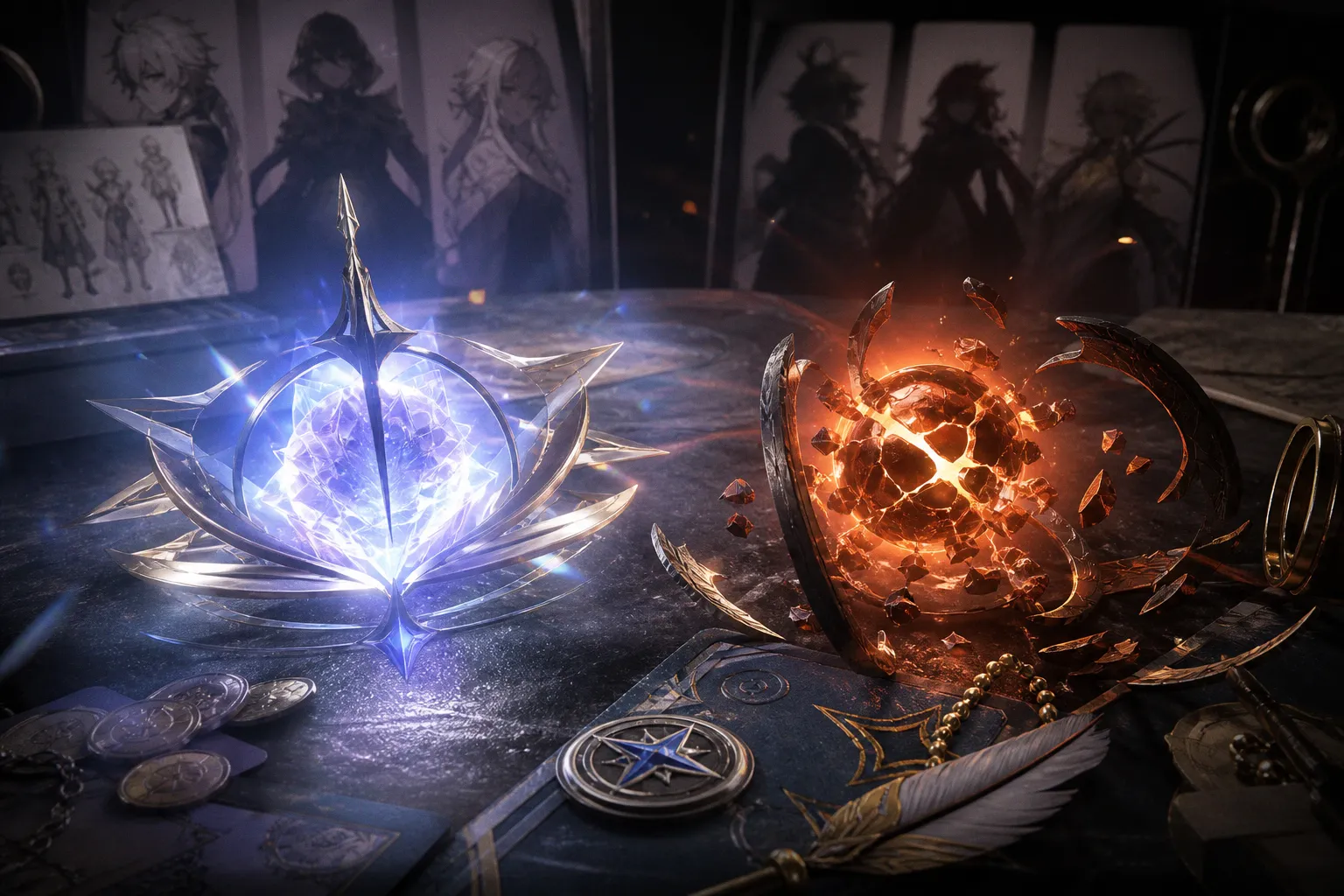
That has not removed hypercarry from the top of the board. Versions 4.2 through 4.4 have instead sharpened a split that is now visible across high-end clears: Castorice and Phainon-style crit carries still control fights when their action advance, buffs, and turn order are protected. Super Break teams, built around Harmony Trailblazer and Fugue, take a different route—breaking the bar early, turning the exposed window into damage, and often surviving without spending a team slot on a conventional sustain.
The current HSR meta tier list is therefore less useful as one vertical ranking than as a map of two competing team engines. One engine concentrates resources into a single closer. The other attacks the enemy’s toughness economy and makes the whole team’s tempo matter.
Hypercarry still owns the cleanest finishing lines
A hypercarry composition has a simple structure: one primary damage dealer, three units devoted to making that dealer take stronger and more frequent turns. The formula is old, but it remains brutal when the pieces are premium.
Castorice and Phainon sit at the center of that argument in the current Honkai: Star Rail tier list discussion. Their value is not merely that they deal high personal damage. It is that their teams can force a predictable sequence: buff window, action advance, enhanced turn, decisive hit. Against an opponent that cannot be reliably weakness-broken—or one that locks its weakness bar—that reliability is a major tactical advantage.
The key word is concentration. Hypercarry teams do not spread investment evenly. Their relic quality, light cone choices, speed tuning, and support rotations all converge on one damage event. If the carry reaches the right breakpoint and the support order is intact, the team can erase a phase before the opponent gets another meaningful action.
That is why traditional crit setups have not been displaced, despite the efficiency of Break. A well-built hypercarry remains the stronger choice in several common competitive conditions:
- The enemy has a weakness lock. Break damage cannot control a bar that cannot be opened. Hypercarry damage continues to operate through the lock rather than waiting for an unavailable window.
- The encounter rewards immediate frontloaded damage. Crit carries can cash in their buffs at series point—the moment before an enemy’s high-impact turn—without first needing to establish a Break state.
- The player already owns elite support pieces. Action advance and high-value buffers raise the ceiling of a top carry more than almost any incremental relic improvement.
- The map asks for flexible damage typing. A hypercarry’s plan is less dependent on matching the enemy’s displayed weakness, even if matching it still improves the overall run.
The weakness of the archetype is equally clear. It is expensive. A hypercarry wants crit rate, crit damage, attack or other offensive scaling, speed in carefully controlled amounts, and support units that do not disrupt the rotation. The player is tuning a formation, not just equipping four individually strong characters.
One awkward speed roll can shift a buffer ahead of the carry at the wrong time. One missed ultimate cycle can turn a clean two-turn finish into a fight where the enemy recovers control. Hypercarry wins hard when it has map control; it gives up more when its formation slips.
Hypercarry does not win because crit is fashionable. It wins because a coordinated buff window can end the fight before the opponent’s mechanics come online.
Super Break changes the damage economy
Super Break teams attack from a different angle. Their central requirement is not a towering crit profile but an intact break sequence: apply the right weakness pressure, collapse toughness, then use Harmony Trailblazer or Fugue to convert that broken state into sustained damage.
This is the core distinction in any serious break effect vs hypercarry HSR comparison. Conventional damage dealers are judged largely by the quality of their personal offensive stats and the size of their amplified hits. Break-oriented units gain a major share of their output from level and Break Effect, with the broken enemy becoming the vulnerable choke point around which the whole team plays.
Harmony Trailblazer and Fugue are not interchangeable decorative supports in this system. They are the enablers that make Super Break a comp identity rather than a collection of characters with high Break Effect. Without that conversion layer, a team can break efficiently and still leave damage on the server.
The practical target is at least 150% Break Effect for a build meant to perform at the upper end. That is not a ceremonial benchmark. Below it, the team may still break bars, but the payoff after the break becomes less convincing, especially when a hard encounter begins adding durability or punishing extra turns.
The reward for reaching the line is unusually efficient roster development. A player does not need to chase a perfect balance of crit rate and crit damage on every attacker. The build path is narrower:
1. Level the Break damage dealer fully. Level carries direct weight in Break scaling, so this is not a minor finishing step.
2. Reach the Break Effect threshold before polishing secondary stats. A mixed build with attractive crit substats can look strong in a character menu while underperforming in an actual Super Break rotation.
3. Tune toughness damage and turn frequency. The team must reach the break first. A high Break Effect unit that arrives after the enemy’s major action has already ceded tempo.
4. Keep the enabler rotation online. Harmony Trailblazer and Fugue create the damage window; losing their cycle turns the lineup into a normal Break squad without the same conversion pressure.
5. Choose targets with exposed weakness bars. The composition is strongest when the enemy gives it something to break and then remains vulnerable long enough to be punished.
This creates an important point often lost in simplified tier lists: Break is not “cheap hypercarry.” It is a separate tactical system. Its best teams do not imitate crit teams with different relics. They build their turn order around toughness depletion, exploit the broken state, and frequently gain defensive room because break delays or disrupts the enemy’s response.
The investment comparison: ceiling against efficiency
The table below captures the split shaping the strongest HSR meta teams comparison in Versions 4.2–4.4.
| Parameter | Hypercarry teams | Break / Super Break teams |
|---|---|---|
| Primary damage model | One carry amplified by three supports | Damage conversion after weakness break, enabled by Harmony Trailblazer or Fugue |
| Main stat pressure | Crit, offensive scaling, speed tuning, support optimization | Character level, Break Effect, toughness damage, turn frequency |
| Core threshold | Precise rotation and buff timing | At least 150% Break Effect for high-end effectiveness |
| Best battlefield | Fights where direct burst matters or weakness bars are locked | Encounters with accessible weaknesses and extended break windows |
| Roster cost | Often high; premium support synergy sharply improves output | More resource-efficient once the enabler core is assembled |
| Defensive profile | Usually depends on a dedicated sustain or fast kill timing | Can perform strongly in sustainless runs through rapid breaking and control |
| Main failure point | Buff order breaks down or the carry misses a key damage window | Enemy resists, locks, or quickly recovers its weakness bar |
The hypercarry advantage is ceiling. The Break advantage is conversion rate: how much useful combat power the account gets from each level, relic, and support slot.
For newer or more selective accounts, that difference matters. Building a crit character is rarely one decision. It is a chain of demands. The carry needs a viable relic baseline; the supports need speed and energy timing; the whole squad needs enough durability to survive until the carry’s next cycle. The apparent simplicity of “put all the buffs on one unit” hides a demanding economy.
Break teams are more forgiving in one specific sense: they can reach functional damage without requiring the same crit perfection. That does not mean they are effortless. They still need correct elements, correct enemy matchups, and a stable enabler core. But the route to a serviceable result is clearer, especially for players who can assemble Break Effect and level their units rather than chase a complete set of premium crit rolls.
This is why resource efficiency has become such a large part of the meta conversation. A team that clears a hard mode with less relic lottery pressure is not automatically the strongest team. It is often the better strategic investment.
Weakness locks are the real counter-pick
The strongest argument against declaring Super Break the default answer is mechanical, not ideological: some enemies do not let you play the Break game on demand.
A weakness lock changes the entire field. The Break team wants to drive toward a single choke point—the toughness bar hitting zero—and then flood the opening with converted damage. If the opponent locks that bar, shields it from meaningful depletion, or shortens the vulnerable interval, the team’s sequence loses its central trigger.
Hypercarry does not have this problem to the same degree. It may still prefer a weakness match, but its damage is not structurally waiting for the enemy to enter Broken state. The carry can maintain pressure through ordinary attacks, buffs, ultimates, and action advances. In a fight built to deny Break tempo, that independence becomes decisive.
This is also the line between an impressive sustainless clear and a repeatable strategy. Break teams can be exceptionally safe when they are breaking rapidly. The opponent is delayed, the team controls the pace, and the absence of a sustain can become an extra damage slot rather than a risk. But that safety is conditional. When the break cycle stalls, the team has fewer places to hide.
A high-difficulty mode such as A8 Wealthy Creator 40 exposes that distinction. Players cannot evaluate a composition only by its fastest favorable clear. They need to ask what happens when the enemy survives the first window, protects the bar, or forces a different target order. Hypercarry is often less efficient but more resilient to that change in terrain. Super Break is often more elegant but more matchup-sensitive.
Break teams are strongest when they own the enemy’s toughness bar. Once that bar is locked, the initiative can switch in a single rotation.
The correct response is not to abandon Break. It is to draft with the encounter in view. If the stage offers accessible weakness and enough time to cycle the break window, Super Break can seize the match early and never release it. If the stage denies those conditions, bring the carry whose damage does not need permission from the toughness gauge.
T0 supports, Elation, and the widening middle of the tier list
Versions 4.2 and 4.3 have also made the support layer impossible to separate from any discussion of the HSR best characters. Silver Wolf LV.999, Sparxie, Evernight, and Tribbie appear in T0 absolute-meta conversations because teams are increasingly decided by what happens around the damage dealer, not only by the damage dealer’s own sheet.
That is the broader meta shift. The top line is no longer simply “which DPS has the highest output?” It is “which engine can field its full sequence most consistently?” Hypercarry needs action advance, buffs, and a clean firing lane. Super Break needs enablers and a breakable target. Elation synergy teams, pushed forward by Trailblazer (Elation) in Version 4.2, have added another high-investment route for accounts able to commit to their internal synergy.
Elation does not erase the hypercarry-versus-Break divide. It complicates the draft board. Players now have another composition family that can justify concentrated investment, particularly when the account can support its specific interactions. The lesson is the same as elsewhere in the current meta: do not rate a character in a vacuum and then assume four high-ranked names create a coherent team.
A roster can contain several T0 units and still fail to produce a stable clear if its turns collide, its toughness damage is misaligned, or its main conversion window arrives too late. Conversely, a narrower roster with Harmony Trailblazer, Fugue, a properly built Break damage dealer, and a favorable enemy weakness can produce a cleaner run than a more expensive crit lineup.
Future patches may alter the support landscape, and the full details of characters beyond Version 4.4 are not settled. That uncertainty matters most for Super Break, whose ceiling is tightly tied to the availability of its specialized enablers. For now, however, the field is clear enough to make the call.
The tier list verdict is a draft decision, not a slogan
Hypercarry remains top-tier because it can force damage through hostile conditions. Castorice and Phainon-style teams still have the finishing power to decide a fight on their own rotation, particularly when weakness mechanics are unreliable or locked.
Super Break remains top-tier because it converts investment into results with ruthless efficiency. At 150% Break Effect and with Harmony Trailblazer or Fugue establishing the window, it can break the opponent’s tempo, build survivability into its offense, and turn a sustainless lineup into a credible high-end option.
The better team is decided before the first turn: by the enemy’s weakness behavior, the account’s support core, and the quality of the investment already on hand. In the mid-2026 HSR meta, that is the real ranking. Hypercarry holds the direct route to the finish. Break owns the map when the toughness bar is available.