Genshin meta tier list: current character rankings and trends
When HoYoverse released Version 6.7 "Luna VIII" on June 30, 2026, the patch introduced a single character — the Cryo Claymore wielder Sandrone — and, through her, an entirely new reaction line in the form of Stellar-Conduct.
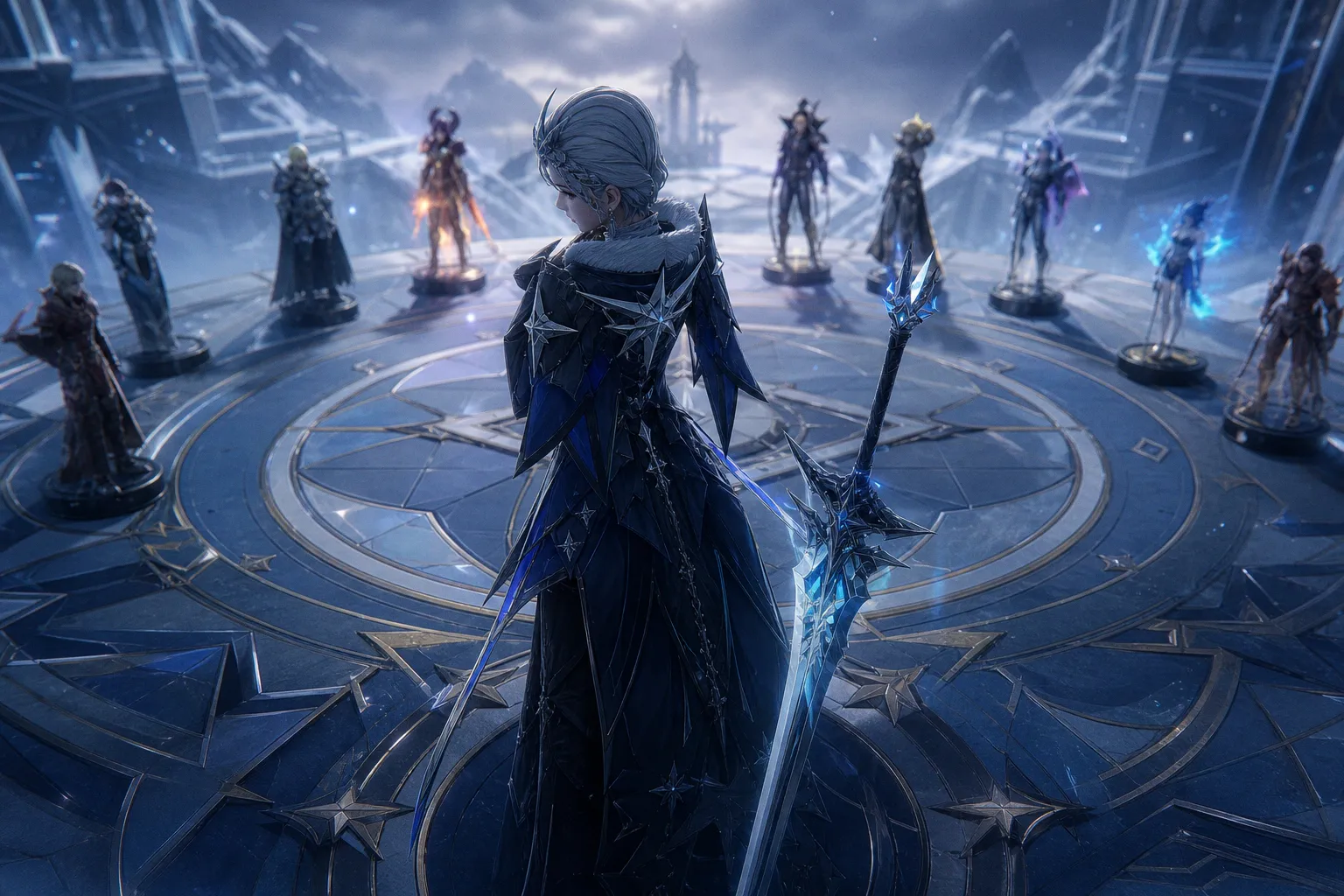
A Structural Pivot in Luna VIII
That combination does not merely augment an existing roster. It restructures the competitive calculus of every Cryo and Electro team operating in Spiral Abyss, and it does so with the kind of deliberate concentration of value that tends to redraw tier boundaries within a single patch cycle.
For analysts tracking the Genshin meta tier list, this is the event of the cycle. Sandrone is, at the time of writing, the only character in the game that enables Stellar-Conduct. That monopoly position translates directly into mandatory inclusion for any team whose long-term competitive thesis depends on the reaction — including refreshed on-field profiles for Wriothesley and Cyno that, prior to Luna VIII, had been operating below their theoretical ceiling.
The current Phase 1 banner window (July 1–21, 2026) features Sandrone alongside Citlali, and Phase 2 (July 21–August 11, 2026) extends with Columbina and Raiden Shogun. The sequencing is itself a strategic signal: HoYoverse is staging a sustained Cryo-Electro pivot across consecutive banner phases, and any organization building around the new meta must allocate accordingly.
Sandrone as a Monopoly Asset: What Stellar-Conduct Actually Changes
The cleanest way to evaluate a meta shift is to ask what previously stranded assets now have a clear use case. Stellar-Conduct does exactly that for two characters — Wriothesley and Cyno — whose on-field DPS profiles had been waiting for a reaction partner capable of converting their Cryo and Electro application into a compounding damage source.
KeqingMains' Sandrone Quick Guide, published July 17, 2026, frames this point with unusual precision: Sandrone is, in Luna VIII, the only character that enables Stellar-Conduct and is therefore required for any on-field Stellar-Conduct playstyle worth running. The investment thesis is therefore not optional. Any roster that intends to clear high-pressure Abyss floors through a Cryo-Electro reaction chain will, by structural necessity, route through her.
Sandrone's monopoly on Stellar-Conduct is the single most consequential variable in the current Genshin meta tier list — it is not a question of strength, but of access.
This framing matters because tier lists in this game are rarely stable across patches. What makes Luna VIII distinctive is that the tier movement is being driven not by a balance adjustment to existing characters but by the introduction of a new economic primitive. Stellar-Conduct is a fresh reaction, and Sandrone is its sole gateway. The implication is that for the duration of this patch, the competitive viability of certain teams is gated by a single acquisition decision.
The Version 6.7 Tier Architecture
Community tier lists have responded to this shift in real time. Icy Veins updated its Version 6.7 rankings on June 30, 2026, and the structure separates characters into Main DPS, Sub DPS, and Support columns. The same character can appear in multiple roles — a fact worth keeping in mind when reading any single-letter rating in isolation.
The current top of each column, as recorded in that ranking, looks like this:
| Role | S+ Tier | S Tier (Selected) |
|---|---|---|
| Main DPS | Flins, Lohen, Mavuika, Nefer, Skirk, Varesa, Varka, Zibai | Arlecchino, Neuvillette, Sandrone, Wriothesley, others |
| Sub DPS | Furina, Yelan, Mavuika, Ineffa, Lauma, Durin, Escoffier, Linnea | — |
| Support | Bennett, Citlali, Columbina, Furina, Nicole, Sucrose, Xilonen | — |
Two structural observations follow. First, Sandrone enters directly at S-tier Main DPS — a notable but not maximal placement — and her true value to the meta sits one layer below the tier letter, in the role-enabling monopoly described above. Second, the support and sub-DPS columns are remarkably stable: Bennett, Furina, Xilonen, and Yelan continue to anchor the utility infrastructure that any competitive team, Sandrone-led or otherwise, must still build around. Mavuika's presence in both the S+ Main DPS and S+ Sub DPS columns is a reminder that role-fluidity, not single-role dominance, is the marker of a top-tier investment.
It is worth being explicit about what this table does and does not show. No community tier list constitutes an official HoYoverse ranking, and the criteria differ across accounts based on constellation depth, weapon access, enemy lineup, and endgame mode. The point of the framework is not to declare a winner but to map the field of viable investments and identify where marginal capital is most efficiently deployed.
Operational Parameters: Rotations, Energy, and Build Infrastructure
Sandrone's role as the Stellar-Conduct gateway imposes specific operational requirements on any team built around her. These are the parameters that determine whether the meta thesis translates into real Spiral Abyss clears.
On-field window and default combos. KQM's guide identifies a roughly 10–13 second on-field window after teammates expend their abilities. At C0, the default combo is E 3[C E] (Q); at C1+, the default combo compresses to E 2[C E] (Q). The compression at C1+ reflects the constellation's damage uplift and is a meaningful variable in rotation design — the player is not merely gaining constellation stats, they are restructuring the cycle.
Energy Recharge targets. The guide's ER benchmarks assume 20-second rotations: 130–165% ER with one additional Cryo teammate, and 120–140% ER with either two additional Cryo teammates or two Electro teammates. KQM also notes that if Favonius weapon assumptions are not met, the ER requirement rises by roughly 10–20%. The guide flags an important operational constraint: if Sandrone's ER requirement exceeds 140%, fully building for ER typically becomes a DPS loss. The implication is that team composition and weapon selection are not cosmetic — they are gating variables for whether the build functions at all.
Main stats and stat priority. Recommended main stats are ATK% / ATK% / CRIT. The stat priority sequence is ER (until the team requirement is met), then CRIT, ATK%, and Elemental Mastery. One counterintuitive point: Cryo DMG Bonus does not affect Stellar-Conduct damage, which makes an ATK% Goblet preferable over a Cryo DMG Goblet in this build. This is the kind of detail that separates an experienced builder from someone reading the artifact screen at face value.
Artifact and weapon recommendations. The 4-piece Disenchantment in Deep Shadows set is identified as Sandrone's best-in-class artifact option for on-field Stellar-Conduct DPS, with 4-piece Gilded Dreams as the fallback. Among 4-star weapons, R5 Tidal Shadow is highlighted as her best option in teams that include a healer, with the additional operational advantage of being forgeable from a Fontaine blueprint — a non-trivial consideration for accounts managing resin budgets across multiple builds.
Constellation scaling. The constellation curve is steep. C1 grants +30% party Stellar-Conduct DMG; C2 adds +40% Charged Attack condensed-beam CRIT DMG and an additional +20% per beam up to three stacks; C4 enables a coordinated Stellar-Conduct hit every 4 seconds; C6 provides +20% to all Stellar-Conduct DMG and, per KQM, more than doubles her personal damage relative to C0. The C1 is positioned as a meaningful inflection point because it does not just boost her own output — it lifts the entire team's reaction damage. That is the signature of a true enabler rather than a pure carry, and it reframes her as infrastructure investment rather than a single-target asset.
Passive caps. Sandrone's A4 passive caps at 160 Elemental Mastery at 2,000 ATK, and her Stellar passive adds up to +14% Base Stellar-Conduct DMG. These caps are not ceiling-defining in isolation, but they reward teams that build ATK density around her — another reason the main-stat recommendations lean toward ATK% rather than elemental damage bonuses.
Assembling the Core: Team Infrastructure Around Sandrone
KQM's baseline team structure is fixed: Sandrone plus one Electro character, plus one additional Cryo character, plus a flex slot. The reasoning is operational. Electro application is a hard requirement to enable Stellar-Conduct, so at least one Electro slot is non-negotiable. The second Cryo character contributes elemental application and activates Cryo Resonance — a 15% CRIT Rate bonus against Cryo-affected enemies, which compounds cleanly with the rest of the build. The flex slot is where roster depth becomes competitive advantage.
Within this structure, Yae Miko is identified as Sandrone's best-in-slot Electro teammate in KQM's current assessment. The pairing is significant because Yae Miko has been a long-standing off-field damage staple whose role in the meta has periodically expanded and contracted across patches. Luna VIII effectively re-elevates her into a tier-defining support for a specific new system. For accounts that already invested in Yae Miko during prior windows, this is a return on prior capital; for accounts that did not, the cost of entry into the Stellar-Conduct meta now includes a second 5-star acquisition.
This is also where Sandrone's investment thesis reveals its limits. KQM's guide is explicit that the character's power is heavily dependent on Yae Miko and other 5-star teammates, that team variety is currently limited, and that accessible 4-star alternatives for the core reaction chain are scarce. A roster built entirely around 4-star characters will struggle to replicate the ceiling of the recommended configuration. The meta is real, but the entry cost is correspondingly high — a structural feature of the patch rather than an incidental observation.
Stellar-Conduct is a high-ceiling system with a narrow on-ramp: the reaction is strong, but the team architecture required to express it is concentrated in 5-star slots.
It is also worth flagging that KQM's own framing treats the Sandrone guide as a snapshot. The organization explicitly states that ongoing testing and discoveries may change the recommendations. That caveat is itself a piece of competitive intelligence: the meta for Stellar-Conduct is in active discovery mode, and any organization building around it should treat current parameters as version-controlled rather than final.
Competitive Positioning and Forward Outlook
The broader competitive picture in Version 6.7 is one of structural differentiation rather than displacement. Established DPS cores — the S+ Main DPS column populated by Mavuika, Skirk, Varesa, Nefer, and others — continue to anchor the highest-pressure Abyss content for accounts built around them. Sandrone does not dethrone them; she carves out a parallel lane whose value is conditional on whether an organization has assembled the supporting roster. That is an important distinction for anyone reading the tier table as a single-objective ranking.
For a roster operating with full Yae Miko investment, a strong Cryo second carry, and the constellation depth to compress her rotation, Sandrone represents a meaningful upgrade to the team's competitive ceiling. For a roster lacking any of these inputs, her value drops sharply, and the more rational allocation may be to maintain existing DPS investment rather than redirect resources into a system that cannot reach its design ceiling without additional acquisitions. The framing of "best Genshin Impact characters" is therefore inseparable from a specific account's existing infrastructure.
The element rankings layer onto this picture in a particular way. Cryo and Electro both gain a fresh reaction pathway that demands dual-element investment. Pyro remains anchored by Mavuika's continued dominance and by Arlecchino's S-tier placement. Hydro retains Neuvillette and Furina as multi-role pillars. Anemo and Geo continue to operate through support-side utility — Sucrose and Xilonen in the S+ support column are not headline characters but their absence would degrade almost every competitive team comp in the game.
What Luna VIII ultimately represents is a calculated redistribution of competitive attention. HoYoverse is staging a sustained Cryo-Electro pivot across consecutive banner phases, the new reaction has a single enabling character, and the supporting cast is concentrated in 5-star units. That is a coherent strategic posture on the developer's part — it creates urgency around specific acquisitions and rewards accounts that already hold the relevant pieces. For analysts tracking the Genshin meta tier list, the through-line is clear: the patch is less about rebalancing existing characters and more about creating a new economic layer in which a single character holds monopoly influence. Whether that layer expands through additional Stellar-Conduct enablers in Version 6.8, or whether it remains a constrained lane dependent on a single gatekeeper, will determine whether Luna VIII is remembered as a foundational retooling of the meta or a tightly scoped experiment. For now, the prudent read is that Sandrone is a strategic acquisition worth the investment for accounts already positioned to extract her value, and a project to defer for those that are not.